


What is the Best Way to Sleep with Sciatica Pain?
Sciatica pain can disrupt even the most peaceful sleep routine, leaving you tossing and turning in search of a position that brings relief. If you’ve ever wondered how to sleep with sciatica or which sleeping positions for sciatica actually work, you’re not alone. Millions of people worldwide struggle with sleeping with sciatica pain every night.
Whether you experience sciatica pain at night that flares suddenly or a dull ache that makes sciatica can’t sleep a nightly reality, finding the right position — and the right approach — can transform your rest. In this guide, we cover:
The best and worst sleeping positions for sciatica
Why sciatica is worse at night
Sciatica exercises in bed
The best pillows for sciatica
How to sit with sciatica
Whether sleeping wrong can cause sciatica
When to see a spine specialist

Why Is Sciatica Worse at Night?
One of the most common questions people ask is: why is sciatica worse at night? Understanding this can help you take targeted steps to reduce nighttime discomfort.
Several factors contribute to sciatica pain at night being worse:
Prolonged pressure on the nerve: When you lie down, certain positions compress or irritate the sciatic nerve more than when you are upright and moving.
Reduced distractions: During the day, activity and mental focus distract from pain. At night, sciatica pain is worse because there is nothing to take your mind off it.
Inflammation cycles: Inflammatory responses in the body can peak in the early morning hours, contributing to sciatica worse at night and morning.
Poor mattress support: A mattress that is too soft or too firm causes misalignment of the spine and hips, aggravating sciatic nerve pain while sleeping.
Static positioning: Unlike daytime movement, staying in one position for hours puts sustained pressure on the lumbar spine and sciatic nerve — this explains why does sciatica get worse at night.
If you find that sciatica pain is worse when lying down or notice sciatica worse when lying down consistently, it is a sign the underlying cause needs professional attention. Persistent unbearable sciatica pain at night should never be ignored.
Why Do I Only Get Sciatica Pain at Night or When Lying Down?
A significant number of people experience sciatica only at night or notice sciatica pain only when lying down — with little to no pain during the day. This pattern is medically significant and worth understanding.
Why sciatica pain only at night can occur:
Positional nerve compression: Certain lying positions place direct pressure on an already sensitised nerve root, triggering pain that was not noticeable while you were upright.
Mattress-related spinal misalignment: A mattress that is too soft allows the hips to sink, closing the intervertebral foramina (the spaces through which nerve roots exit the spine). This directly explains sciatic nerve pain when lying down.
Reduced protective muscle activity: During the day, your core and back muscles actively stabilise the spine. When you relax in bed, this support disappears, allowing vertebrae to shift slightly and compress the nerve.
Inflammatory mediator activity: Inflammatory chemicals around a herniated disc or irritated nerve can concentrate in one area during prolonged stillness, intensifying sciatica pain while lying down.
If you experience sciatic pain only when lying down and never during the day, discuss this with a spine specialist. In rare cases, sciatica pain only at night can indicate a non-mechanical cause (such as a tumour or infection) requiring urgent investigation. For most people, however, sciatica only when lying down is positional and responds well to the strategies in this guide.
First Step: Find Out Why You Have Sciatica Nerve Pain
The first step to getting relief is identifying the cause of your sciatica. This may require a visit to a spine specialist and some sessions with a physical therapist.
Common causes of sciatica include:
Bulging or slipped (herniated) disc
Compressed or irritated sciatic nerve
Tight muscles in the back or hips (piriformis syndrome)
Degenerative disc disease
Spinal stenosis (narrowing of the spinal canal)
Vertebrae that are out of alignment (spondylolisthesis)
Trauma or injury to the sciatic nerve from a fall or accident
Tumour or growth near the sciatic nerve
The cause of your sciatic nerve pain affects which sleeping positions aggravate your symptoms and which provide relief. For example, someone with a herniated disc and sciatica may find back sleeping more comfortable, while someone with spinal stenosis might prefer the fetal position. Knowing the cause is the foundation of effective management, including how to sleep with herniated disc and sciatica specifically.
What Is the Best Way to Sleep with Sciatica Pain?
Finding the best sleeping position for sciatica is highly individual, but these evidence-backed positions tend to offer the most relief for the majority of people.
✅On your back with a pillow under your knees
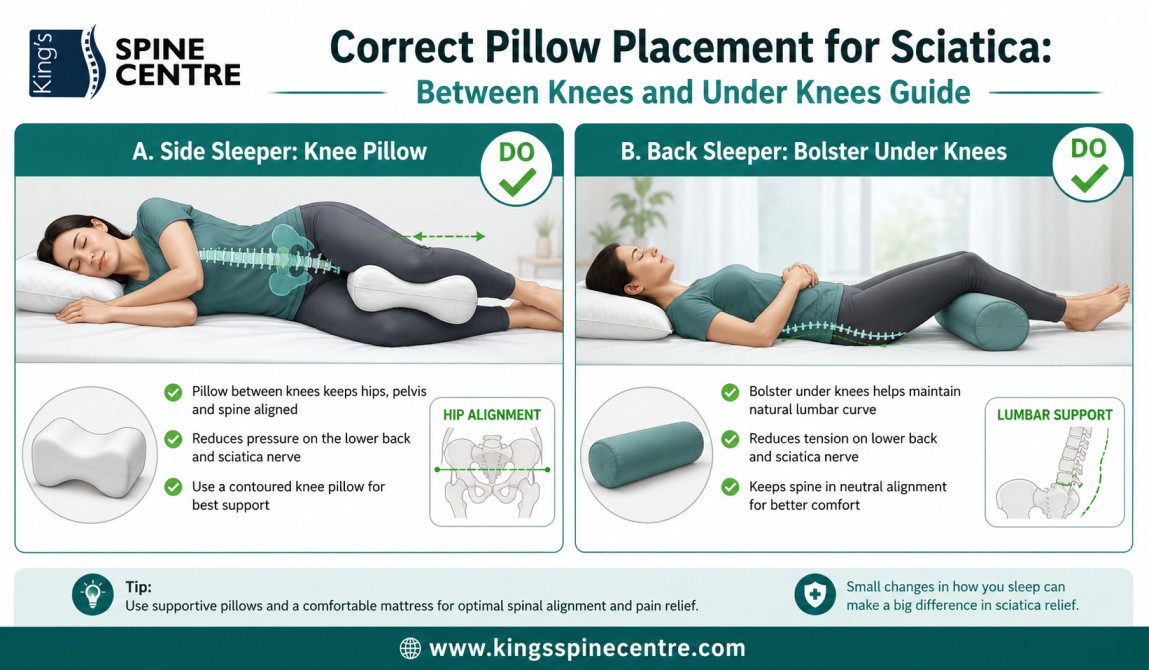
This is one of the best sleep positions for sciatica and lower back pain. Lying on your back keeps the spine in a neutral alignment, and placing a pillow under your knees reduces pressure on the lumbar spine and sciatic nerve.
How to do it:
- Lie flat on your back on a firm, supportive surface.
- Place one or two pillows under your knees to keep your heels slightly elevated.
- Support your neck with an appropriate pillow.
- Place a small rolled towel under the small of your back for extra lumbar support if needed.
This is considered the best lying position for sciatica by many spine specialists, particularly for lumbar disc herniation. The pillow under knees spine technique is simple, free, and immediately effective for many people.

✅ 1. On Your Back with a Pillow Under Your Knees
This is one of the best sleep positions for sciatica and lower back pain. Lying on your back keeps the spine in a neutral alignment, and placing a pillow under your knees reduces pressure on the lumbar spine and sciatic nerve.
How to do it:
Lie flat on your back on a firm, supportive surface.
Place one or two pillows under your knees to keep your heels slightly elevated.
Support your neck with an appropriate pillow.
Place a small rolled towel under the small of your back for extra lumbar support if needed.
This is considered the best lying position for sciatica by many spine specialists, particularly for lumbar disc herniation. The pillow under knees spine technique is simple, free, and immediately effective for many people.
✅ 2. On Your Side with a Pillow Between Your Knees
Side sleeping with a pillow between your knees is one of the most recommended sciatica sleeping positions. It works by aligning your hips, pelvis, and spine, reducing the rotational stress that aggravates the sciatic nerve.
How to do it:
Lie on your side with your knees slightly bent.
Place a firm pillow between your knees to keep your hips aligned.
Avoid letting your top hip rotate forward.
Use a pillow to support your arm if needed.
For those asking can I sleep on my side with sciatica, the answer is yes — with the right pillow support. For left sided sciatica, the best sleeping position for left sided sciatica is generally on your right side. For right-sided symptoms, the best sleeping position for right sided sciatica is typically on your left side, taking pressure off the affected nerve root.
✅ 3. The Fetal Position
Sleeping in the fetal position is another effective relief sciatica sleeping position, especially for people with spinal stenosis. Curling the knees toward the chest gently opens the spaces between vertebrae, reducing nerve compression.
How to do it:
Lie on your side and gently draw your knees toward your chest.
Keep your spine gently rounded — do not force it.
Place a pillow between your knees for additional hip alignment.
Hug a body pillow along your torso for extra support.
This sleeping position for sciatica pain is particularly helpful if you experience sciatica pain when lying down due to stenosis or foraminal narrowing.
✅ 4. Reclined Position (Adjustable Bed or Recliner)
For people who find sciatica pain while sleeping is unbearable in any flat position, sleeping semi-reclined can be a practical solution. An adjustable bed or recliner that elevates your upper body slightly while bending the knees reduces spinal compression. This position is particularly helpful for isthmic spondylolisthesis.
❎ Worst Sleeping Position: On Your Stomach Without Support
Stomach sleeping without a pillow under the hips is one of the worst sleeping positions for lower back pain and sciatica. It causes your lower back to overarch, puts torsion on the lumbar spine and sciatic nerve, and forces the neck to rotate — adding cervical strain. It is considered one of the worst positions for sciatica without question.
If you prefer stomach sleeping:
Place a firm pillow under your hips and lower abdomen to reduce lumbar hyperextension.
Use a thin pillow (or none at all) under your head.
Use a body pillow to gradually transition to side sleeping over time.
Those wondering is it better to sit or lay down with sciatica should note that both prolonged sitting and lying without support can worsen symptoms. Regular movement and position changes throughout the day and night are most beneficial.

How to Sleep with Sciatica Pain During Pregnancy
Pregnancy is a common trigger for sciatic nerve pain, as the growing uterus can press on the sciatic nerve. If you are wondering how to sleep with sciatica pain during pregnancy, the following guidelines apply:
Sleep on your left side: This improves blood flow and reduces pressure on the vena cava. Use a pregnancy pillow between your knees and under your belly.
Use a full-length pregnancy pillow: These simultaneously support the belly, back, hips, and knees — ideal for sleeping positions for sciatica during pregnancy.
Avoid lying flat on your back in later pregnancy: This can compress major blood vessels and worsen sciatic symptoms.
Gentle prenatal stretches before bed: Light stretching reduces muscle tension around the sciatic nerve and makes it easier to fall asleep.
Always consult your OB-GYN or a spine specialist before starting any new treatment during pregnancy.

Sciatica Exercises in Bed to Relieve Pain at Night

One of the most effective ways to reduce sciatic nerve pain at night is to perform gentle sciatica exercises in bed before sleeping. These ease muscle tension, reduce inflammation, and take pressure off the sciatic nerve.
1. Knee-to-Chest Stretch
Lie on your back. Gently pull one knee toward your chest and hold for 20–30 seconds. Repeat on both sides. This stretch helps decompress the lumbar vertebrae and eases sciatic nerve pain sleeping position transitions.
2. Piriformis Stretch
Lie on your back with knees bent. Place one ankle on the opposite thigh, then gently pull the bottom leg toward your chest. Hold for 30 seconds per side. This targets the piriformis muscle, a common contributor to sciatica pain at night.
3. Pelvic Tilts
Lie on your back with knees bent and feet flat. Flatten your lower back against the mattress by tightening your core, hold for 5 seconds, then release. Repeat 10 times. Pelvic tilts stabilise the lumbar spine before sleeping.
4. Child’s Pose (Gentle Bed Version)
Kneel on the bed and sit back toward your heels, stretching your arms forward. This decompresses the lumbar spine and is an easy sciatica pain exercise to do at bedtime.
These positions to relieve sciatica require no equipment and take just a few minutes before settling into your preferred sleep position.
How to Relieve Sciatica Pain in Bed: Helpful Tips
Changing your sleeping position is just the beginning. Here are additional strategies for how to relieve sciatic nerve pain at night and improve overall sleep quality.
Choose the Right Mattress
Sleep on a medium-firm mattress, which provides the best balance of support and pressure relief for the back, hips, and shoulders. If your mattress is too soft, placing a plywood board underneath can help. When exploring beds for sciatica, prioritise medium-firm options with good lumbar support. If your mattress is over 7–8 years old and you consistently wake up with sciatica pain, it may be time for a replacement.
Use a Body Pillow
A body pillow prevents you from rolling from your side onto your stomach while sleeping and provides consistent support throughout the night, reducing sciatica pain while sleeping.
Apply Heat or Ice
Using an ice pack or heating pad on your lower back before bed limits pain and relieves muscle tightness. Alternating between heat and cold can be particularly effective for sciatica leg pain at night and sciatica spasms at night.
Take a Warm Bath Before Bed
A warm bath or shower before bedtime relaxes the muscles surrounding the sciatic nerve, reducing compression and helping you fall asleep more comfortably. This is one of the simplest answers to how to help sciatica pain at night.
Consider OTC Pain Relievers
A short course of over-the-counter NSAIDs such as ibuprofen may ease sciatic symptoms before sleep. Always consult your doctor before starting any medication, particularly if you have other health conditions.
Is Rest Good for Sciatica?
A common question is: is rest good for sciatica? The answer is nuanced. Short-term rest can relieve acute pain, but prolonged bed rest is not recommended. Does rest help sciatica long-term? Research shows that staying gently active leads to better outcomes than complete rest. Similarly, does lying down help sciatica temporarily? Yes — but only in a supportive position. Does lying down make sciatica worse? It can, if your position compresses the nerve or your mattress provides inadequate support.
Establish Good Sleep Hygiene
Sciatica sleeping dos and don’ts extend beyond your physical position:
Do: Maintain a consistent bedtime and wake time.
Do: Keep your room at a cool, comfortable temperature.
Do: Avoid caffeine and heavy meals in the 2–3 hours before bed.
Don’t: Use your phone or screen in bed — blue light disrupts sleep quality.
Don’t: Stay in one position all night — gently shift positions if you wake up in pain.
Sleeping on the Floor for Sciatica
Some people ask is sleeping on the floor good for sciatica or should I sleep on the floor with lower back pain. A firm floor surface can improve spinal alignment for those whose mattresses are too soft. However, sleeping on the floor for sciatica is not ideal for everyone — especially older adults or those with hip issues. Try it with a firm yoga mat or blanket underneath for cushioning.
Best Pillow for Sciatica: What to Use and Where to Place It
The right sciatica pillow for sleeping can make a meaningful difference in your pain levels overnight. Here is a breakdown of what works, where to use it, and what to look for.
Pillow Between the Knees
A firm, contoured pillow for in between knees is one of the most effective tools for side sleepers with sciatica. It prevents the top knee from dropping forward, which would rotate the pelvis and stretch the piriformis muscle across the sciatic nerve. Look for a knee pillow that:
Has an hourglass or contoured shape to grip between the knees without slipping.
Is firm enough to maintain hip alignment throughout the night.
Is approximately 6–8 inches thick to keep the hips level.
Pillow Under the Knees
For back sleepers, a pillow under knees spine approach is ideal. Place one or two standard pillows — or a dedicated bolster pillow — beneath your knees to maintain a slight bend. This flattens the lumbar curve and reduces disc pressure. A cylindrical bolster tends to stay in place better than a standard pillow.
Pillow for Sciatica Buttock Pain
If your sciatica originates from piriformis syndrome or sacroiliac joint dysfunction, you may experience significant buttock pain. A pillow for sciatica buttock pain — such as a coccyx or donut cushion — can help when sitting. For sleeping, side lying with a firm pillow between the knees is the most effective strategy to relieve pressure on the buttock area.
Body Pillow
A full-length body pillow is one of the best investments for anyone sleeping with sciatica pain. It simultaneously supports the knees, prevents rolling onto the stomach, and gives the arms somewhere to rest — reducing overall muscular tension that contributes to nerve irritation overnight.
Mattress Topper
If your mattress is too soft and contributing to sciatica pain while sleeping, a firm mattress topper (latex or high-density foam) can temporarily improve spinal alignment without replacing the entire mattress — a cost-effective first step before investing in a new bed.
How to Sit with Sciatica: Positions That Help vs. Hurt
Many sciatica sufferers struggle equally with sitting. Understanding how to sit with sciatica correctly is just as important as knowing the right sleeping positions — because poor daytime posture directly worsens night-time pain.
Best way to sit with sciatica:
Keep your feet flat on the floor: Dangling feet tilt the pelvis and increase lumbar pressure.
Sit with your hips slightly higher than your knees: Use a wedge cushion if needed. This maintains the natural lumbar curve and reduces sciatic nerve compression.
Avoid crossing your legs: This rotates the pelvis unevenly and can pinch the piriformis muscle against the sciatic nerve.
Use lumbar support: A rolled towel or lumbar cushion placed at the curve of your lower back keeps the spine in a neutral position.
Take movement breaks every 30 minutes: Prolonged sitting is one of the most common triggers for sciatic flare-ups. Stand, walk, or gently stretch regularly.
For those asking how to sit in bed with sciatica, prop yourself up with pillows behind your back so you are not hunching forward, and keep your legs slightly elevated. Avoid sitting straight up in bed with your legs flat — this tightens the hamstrings and pulls on the sciatic nerve.
When it comes to sitting comfortably with sciatica, the key principle is: neutral spine, supported lumbar curve, and weight evenly distributed across both sitting bones. Avoid soft sofas or bucket seats that cause you to sink and round your lower back.
Regarding does sitting on a pillow help sciatica — yes, a firm wedge or donut cushion can reduce direct pressure on the coccyx and piriformis area, making seated positions more tolerable during a flare-up. And if you are wondering does elevating legs help sciatica, yes — elevating the legs reduces lumbar lordosis and decreases disc pressure. A wedge pillow under both legs while lying on your back achieves this effectively.
Waking Up with Sciatica Pain: Causes and Solutions
Waking up with sciatica pain is a frustrating experience that signals something about your sleeping position, mattress, or underlying condition needs to change. If you regularly experience sciatica worse after sleeping or notice sciatica pain after sleeping, here is what may be happening.
Why You Wake Up with Sciatica
You stayed in one position too long: Sustained pressure on the nerve throughout the night causes cumulative irritation that peaks when you first move in the morning.
Morning inflammation surge: Inflammatory processes naturally intensify in the early morning hours, which is why sciatica worse at night and morning is such a common complaint.
Your mattress has worn out: A sagging mattress creates uneven spinal support, causing muscles to overcompensate and leading to sciatica pain after sleeping.
You moved into a bad position during sleep: Many people fall asleep in a good position but unconsciously roll onto their stomach or into a twisted position during the night.
How to Reduce Morning Sciatica Pain
Set an alarm to shift positions: If possible, change your sleeping position every 2–3 hours to prevent sustained nerve compression.
Stretch before getting up: Before rising, perform a slow knee-to-chest stretch on both sides while still lying in bed. This significantly reduces morning sciatica stiffness.
Get out of bed carefully: Roll onto your side first, then push yourself up using your arms rather than sitting straight up from flat. This avoids sudden lumbar flexion.
Use a body pillow or bolster: These prevent you from rolling into a harmful position during sleep.
Evaluate your mattress: If sciatica after sleeping is a persistent problem and your mattress is over 7–8 years old, it may be time for a replacement.
Can a Bed or Sleeping Wrong Cause Sciatica?
Many people ask: can sleeping wrong cause sciatica? or can a bed cause sciatica? Sleeping position and mattress quality are unlikely to be the primary cause of true sciatica in a healthy spine, but they can absolutely trigger or worsen an existing vulnerability.
How Sleep Can Trigger a Sciatica Flare
If you already have a bulging disc, tight piriformis muscle, or narrowed spinal canal, a poor sleeping position can be enough to provoke a full sciatica episode. Sciatica from sleeping wrong typically happens when:
You sleep on your stomach without support, causing lumbar hyperextension.
You sleep on a mattress that is too soft, allowing the lumbar spine to sag out of alignment.
You sleep in a twisted position with hips rotated and knees stacked unevenly.
Your neck and lower back are unsupported, creating a chain of compensatory muscle tension.
Sciatica Spasms at Night
Sciatica spasms at night — sudden, sharp muscle contractions in the lower back, buttock, or leg — are often triggered by an awkward sleeping position compressing an already irritated nerve. To reduce them:
Apply a heating pad to the lower back before bed to reduce muscle excitability.
Perform the piriformis stretch before sleep.
Ensure your sleeping position supports neutral spinal alignment.
While sleeping wrong rarely causes sciatica from scratch, it is a very common trigger for those with an underlying spinal vulnerability. Addressing both the sleeping environment and the root cause together gives the best outcomes.

When to See a Doctor for Sciatica Pain at Night
While the tips above can provide meaningful relief, some situations require prompt medical attention. See a spine specialist if:
Sciatica pain at night is suddenly severe or progressively worsening.
Sciatica can’t sleep despite trying multiple positions and home remedies for more than 4–6 weeks.
You experience numbness, weakness, or tingling in the leg or foot.
You have loss of bladder or bowel control (this is a medical emergency).
Sciatica pain worse at night is accompanied by fever or unexplained weight loss.
Waking up with sciatica pain every morning despite rest and conservative management.
Advanced diagnostic tools such as MRI and CT scans can identify the precise cause of your sciatic nerve pain and guide targeted treatment — from physiotherapy and injections to minimally invasive surgical options where needed.
Visit King’s Spine Centre Dubai for Sciatica Treatment
Whatever is causing your sciatica pain, don’t assume you have to live with it. If it is affecting your sleep and quality of life, visit King’s Spine Centre. Our spine specialists in Dubai will evaluate your condition using advanced diagnostic tools including MRI and CT scans, and work with you to develop a personalised treatment plan — whether that is physiotherapy, pain management, or minimally invasive surgery.
With appropriate medical care, you can find meaningful, lasting relief from sciatic nerve pain and enjoy restful, restorative sleep again.
Schedule your appointment today.
FAQs
The best sleeping position for sciatica is typically on your back with a pillow under your knees, or on your side with a pillow between your knees. Both maintain spinal alignment and reduce pressure on the sciatic nerve.
Sciatica is worse at night due to sustained nerve pressure from lying in one position, reduced distraction from pain, and natural cycles of inflammation. A poor mattress or unsupported sleeping position also contributes.
For how to sleep with sciatica pain in left leg, try lying on your right side with a pillow between your knees. This removes direct pressure from the left side of the lumbar spine.
For how to sleep with sciatica pain in right leg, lying on your left side with a pillow between your knees is generally recommended. This reduces compression on the right-side nerve roots.
The worst sleeping position for lower back pain is flat on your stomach without pillow support, which causes lumbar hyperextension. Sleeping in a twisted position without hip alignment is also harmful.
To stop sciatica pain at night, adjust your sleeping position, use pillow support under or between your knees, do pre-sleep stretches, apply heat or ice, and consider OTC anti-inflammatories. If pain persists, consult a spine specialist.
Neither prolonged sitting nor sustained lying is ideal. Is it better to sit or lay down with sciatica depends on your specific condition. Gentle movement and position changes throughout the day and night are generally most beneficial.
Does sleeping with a pillow between your legs help sciatica? Yes — it helps align the hips and reduce rotational stress on the lumbar spine and sciatic nerve during side sleeping.
Yes. Side sleeping with sciatica is well-tolerated when a firm pillow is placed between the knees. Sleeping on the side opposite to your pain is usually more comfortable.
When getting into bed, sit on the edge first, then gently lower yourself sideways using your arms, and roll into your preferred position. This avoids sudden lumbar flexion. How to lay in bed with sciatica comfortably depends on using adequate pillow support from the start.
Does elevating legs help sciatica? Yes — elevating the legs reduces lumbar lordosis and decreases pressure on the lumbar discs and nerve roots. A wedge pillow under both legs while lying on your back is effective.
If your sciatic nerve hurts when you lay down, it is likely because your lying position compresses the nerve root directly, your mattress does not support proper spinal alignment, or inflammation around the nerve intensifies with prolonged stillness. Trying the positions outlined in this article and reviewing your mattress are the first steps.
Medical Disclaimer
This blog is for informational purposes only and is not a substitute for professional medical advice, diagnosis, or treatment. Always consult your physician or a qualified healthcare provider regarding any medical questions or concerns.
Review Note
This content has been medically reviewed by the spine care team at King’s Spine Centre, Dubai, to ensure accuracy and relevance. Our team follows evidence-based guidelines and uses advanced diagnostic tools such as MRI and CT scans to evaluate spinal conditions.
