


What Is the Best Painkiller for Spinal Stenosis?
If your back or legs ache every time you stand or walk, you have probably typed one question into Google more than once: what is the best painkiller for spinal stenosis? It is a fair thing to want — a single tablet that simply switches the pain off. The honest answer is that the best painkiller is the one matched to your type of pain, your age, your other health conditions, and how severe your symptoms are. For one person that is a simple anti-inflammatory; for another it is a nerve-pain medicine, a topical cream, or a combination guided by a spine specialist.
This guide from King’s Spine Centre in Dubai walks through every medication commonly used for spinal stenosis — what it does, who it suits, and where it falls short — so you can have a smarter conversation with your doctor. If you are also exploring procedures, our companion guide on the newest treatment for spinal stenosis covers the latest non-surgical and minimally invasive options.
Quick Answer: Is There a Single “Best” Painkiller for Spinal Stenosis?
No single painkiller works best for everyone, because spinal stenosis creates two different kinds of pain. As a general rule:
Mild to moderate pain: doctors usually start with NSAIDs (anti-inflammatories) such as ibuprofen, naproxen or meloxicam.
Burning, shooting or radiating leg pain: nerve-pain medicines like gabapentin or pregabalin are often more effective.
Muscle spasm: a short course of a muscle relaxant can help.
Severe or persistent pain: an epidural steroid injection or a specialist-led plan usually works better than stronger oral painkillers.
In short, the right medication for spinal stenosis depends on what is causing your pain — which is why an accurate diagnosis matters more than any single drug.
Understanding Spinal Stenosis Pain (Why It Needs Different Painkillers)
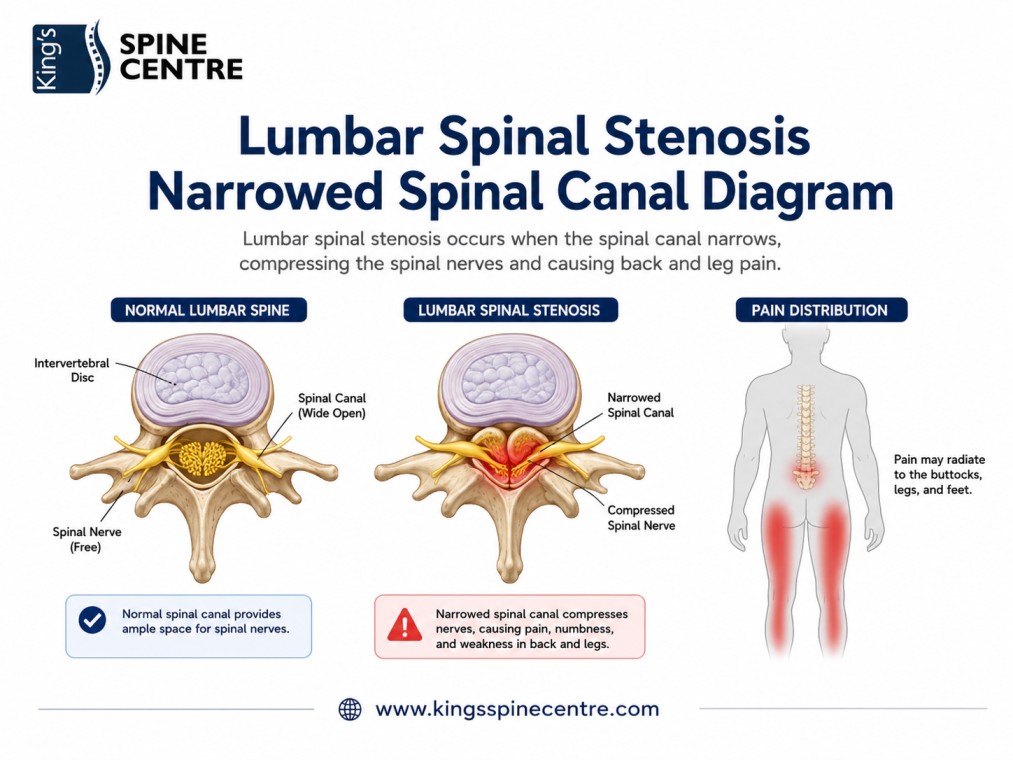
Spinal stenosis is a narrowing of the spaces inside the spine — most often in the lower back (lumbar spinal stenosis) or neck — which presses on the nerves. That pressure produces pain in two ways, and each responds to a different medicine:
Mechanical and inflammatory pain — a deep ache from worn joints and arthritis in the spine. This responds best to anti-inflammatory medication.
Neuropathic (nerve) pain — burning, tingling, numbness or shooting pain that travels into the legs (often called neurogenic claudication). This responds better to nerve-specific medicines.
Knowing which type dominates is the single best guide to which painkiller will actually help you.
The Best Painkillers and Medications for Spinal Stenosis
1. NSAIDs — Usually the First Choice
For most people with mild to moderate symptoms, NSAIDs (non-steroidal anti-inflammatory drugs) are the first-line painkiller. They ease pain and reduce the inflammation around compressed nerves. Common options include ibuprofen, naproxen, diclofenac and meloxicam — the last is often preferred for longer-term use because it is taken once daily.
What to watch: long-term NSAID use can irritate the stomach, and affect the kidneys, blood pressure and heart. They are used at the lowest effective dose for the shortest time, and with extra caution in older adults or anyone with ulcers, kidney or heart problems.
2. Paracetamol (Acetaminophen)
Paracetamol eases mild pain and is gentle on the stomach, making it a reasonable choice for people who cannot tolerate NSAIDs. It does not reduce inflammation, so on its own it is often not enough for stenosis-related nerve pain — but it can be safely combined with other treatments. Stay within the recommended daily limit, as high doses can harm the liver.
3. Gabapentin and Pregabalin — for Nerve Pain
When stenosis causes burning, tingling or shooting pain down the legs, ordinary painkillers often disappoint. Gabapentin (Neurontin) and pregabalin (Lyrica) are made for exactly this kind of nerve pain, calming overactive nerve signals.
Does gabapentin help spinal stenosis? It can help some patients — particularly those with significant leg symptoms — though the evidence is mixed and it does not work for everyone. It is usually started low and increased slowly. Drowsiness, dizziness and leg swelling are the most common side effects, so it needs careful supervision, especially in older patients.
4. Muscle Relaxants — for Spasm
Do muscle relaxers help spinal stenosis? They do not treat the narrowing itself, but when stenosis triggers painful muscle spasms in the back, a short course of a muscle relaxant such as cyclobenzaprine, tizanidine or baclofen can ease that tightness and help you move and sleep. Because they cause drowsiness and can be habit-forming, they are meant for short-term use — not as a daily long-term painkiller.
5. Antidepressants for Nerve Pain
At low doses, certain antidepressants are genuine nerve-pain treatments, separate from their role in mood. Duloxetine (an SNRI) and amitriptyline (a tricyclic) can dampen chronic nerve and musculoskeletal pain, and are sometimes added when nerve-pain medicines alone are not suitable or not enough.
6. Topical Pain Relief — Creams, Gels and Patches
Looking for the best cream for spinal stenosis? Topical options such as diclofenac gel, lidocaine patches and capsaicin cream are applied directly over the painful area. They deliver relief with far less medication reaching the rest of the body, which makes them a useful, lower-risk add-on — particularly for older adults — although they help surface and muscular pain more than deep nerve compression.
7. Opioids and Tramadol — a Last Resort
Stronger painkillers such as tramadol or other opioids are generally reserved for severe, short-term flare-ups when safer options have not worked. They carry real risks of dependence, constipation, drowsiness and reduced effect over time, so reputable spine specialists avoid them as a long-term solution for a chronic condition like spinal stenosis.
8. Corticosteroids and Epidural Steroid Injections
When inflammation around the nerves is driving the pain, a short course of oral corticosteroids — or, more commonly, an epidural steroid injection — can settle it. An injection places anti-inflammatory medication directly around the compressed nerve and can give weeks to months of relief, often enough to make physical therapy possible. This is a procedure performed by a specialist rather than a tablet.
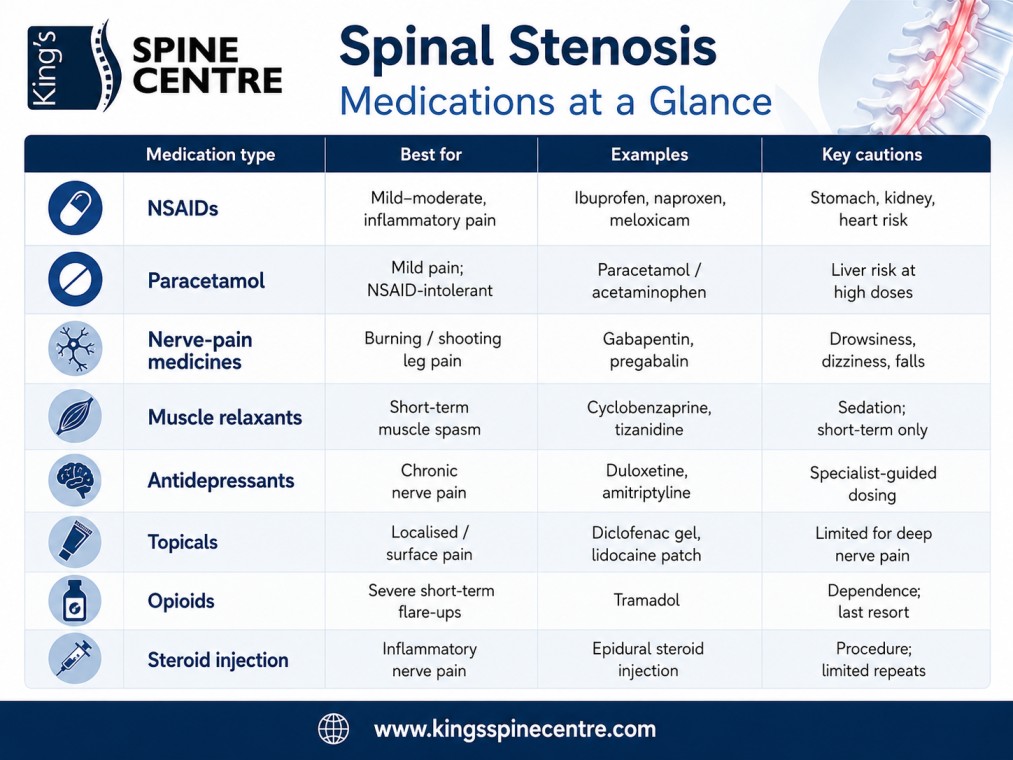
Spinal Stenosis Medications at a Glance
| Medication type | Best for | Examples | Key cautions |
| NSAIDs | Mild–moderate, inflammatory pain | Ibuprofen, naproxen, meloxicam | Stomach, kidney, heart risk |
| Paracetamol | Mild pain; NSAID-intolerant | Paracetamol / acetaminophen | Liver risk at high doses |
| Nerve-pain medicines | Burning / shooting leg pain | Gabapentin, pregabalin | Drowsiness, dizziness, falls |
| Muscle relaxants | Short-term muscle spasm | Cyclobenzaprine, tizanidine | Sedation; short-term only |
| Antidepressants | Chronic nerve pain | Duloxetine, amitriptyline | Specialist-guided dosing |
| Topicals | Localised / surface pain | Diclofenac gel, lidocaine patch | Limited for deep nerve pain |
| Opioids | Severe short-term flare-ups | Tramadol | Dependence; last resort |
| Steroid injection | Inflammatory nerve pain | Epidural steroid injection | Procedure; limited repeats |
What Is the Best Medication for Severe Spinal Stenosis?
For severe spinal stenosis, no oral painkiller reliably controls the pain on its own, and simply moving to stronger tablets usually adds side effects without solving the underlying compression. The more effective route is a combined, specialist-led plan: targeted nerve medication, an epidural steroid injection to calm inflammation, structured physical therapy, and — when symptoms are disabling or there is leg weakness, numbness, or bladder or bowel changes — an assessment for a minimally invasive or surgical procedure to relieve the pressure directly. Severe or rapidly worsening symptoms are a reason to see a spine specialist promptly rather than relying on painkillers alone.
Pain Management for Spinal Stenosis in Elderly Patients
Spinal stenosis is most common after the age of 60, and older adults need extra care with painkillers. NSAIDs carry higher stomach, kidney and heart risks; gabapentin, pregabalin, muscle relaxants and opioids all increase drowsiness and the risk of falls. For this reason doctors often build relief from the safest options upward — topical treatments, paracetamol where appropriate, the lowest effective doses, physical therapy and well-placed injections — rather than starting with strong drugs.
Beyond Painkillers: Getting Lasting Relief for Spinal Stenosis
Medication manages symptoms, but it does not widen the spinal canal — so the most durable spinal stenosis relief usually comes from combining medicine with other approaches:
Physical therapy and exercise to strengthen the core and improve flexibility — often the single most useful long-term step.
Posture and activity changes — many people find that leaning forward (for example on a shopping trolley) eases leg pain, because it opens up the spinal canal.
Weight management to reduce the load on the lower back.
Pain management procedures such as epidural steroid injections for flare-ups.
Minimally invasive and surgical options when conservative care is not enough.
To relieve leg pain from spinal stenosis specifically, the combination of nerve-targeted medication, forward-flexion exercises and physical therapy usually works better than painkillers alone. You can explore the procedure side in our guide to the newest treatment for spinal stenosis.

When to See a Spine Specialist in Dubai
Painkillers are a bridge, not a cure. See a spine specialist if your pain is severe, getting worse, waking you at night, spreading down your legs, or coming with numbness, weakness, or any change in bladder or bowel control — the last of these needs urgent attention.
At King’s Spine Centre in Dubai, our team pinpoints the exact cause of your symptoms using advanced imaging and builds a personalised plan — from medication and physical therapy to image-guided injections and minimally invasive treatment — so you are not left guessing which painkiller to try next.
Book a consultation with King’s Spine Centre, Dubai to find the safest, most effective relief for your spinal stenosis.
Frequently Asked Questions (FAQs)
What is the best painkiller for spinal stenosis?
There is no single best painkiller for everyone. NSAIDs such as ibuprofen, naproxen or meloxicam are usually the first choice for inflammatory pain, while gabapentin or pregabalin are often better for nerve-related leg pain. The right option depends on your type of pain, age and overall health.
Does gabapentin help spinal stenosis?
Gabapentin can help patients whose stenosis causes burning, tingling or shooting pain in the legs, by calming overactive nerve signals. The evidence is mixed and it does not help everyone, so it is started at a low dose and supervised by a doctor.
What is the best muscle relaxer for spinal stenosis?
Muscle relaxants such as cyclobenzaprine, tizanidine or baclofen can ease painful spasms, but they treat the spasm rather than the stenosis itself and are intended for short-term use because they cause drowsiness.
Is meloxicam good for spinal stenosis?
Meloxicam is an NSAID often used for spinal stenosis because it is taken once daily and controls inflammatory pain well. As with all NSAIDs, it needs care in people with stomach, kidney or heart concerns.
Can tramadol be used for spinal stenosis?
Tramadol and other opioids are generally reserved for severe, short-term flare-ups when safer options have failed. They are not recommended as a long-term treatment because of the risk of dependence and reduced effectiveness over time.
What is the best cream for spinal stenosis?
Topical diclofenac gel, lidocaine patches and capsaicin cream can relieve localised and muscular pain with less whole-body medication. They are a useful add-on, especially for older adults, but help less with deep nerve compression.
How do you relieve leg pain from spinal stenosis?
Leg pain usually responds best to a combination of nerve-targeted medication, forward-flexion exercises, physical therapy and, for flare-ups, epidural steroid injections — rather than painkillers alone.
What is the best medication for severe spinal stenosis?
Severe cases rarely respond to one tablet. A specialist-led plan combining nerve medication, steroid injections, physical therapy and, where needed, a minimally invasive or surgical procedure is more effective than escalating to stronger painkillers.
Medical Disclaimer
This content is for informational purposes only and is not a substitute for professional medical advice, diagnosis, or treatment. Always consult your physician or a qualified healthcare provider regarding any medical questions, symptoms, or conditions.
Medically Reviewed
Reviewed by the spine care team at King’s Spine Centre, Dubai — a multidisciplinary team of spine specialists, neurosurgeons, pain management physicians and physiotherapists following evidence-based, JCI-accredited care standards.
