


Symptoms of Nerve Damage After Back Surgery: Signs, Causes, and When to Get Help
Back surgery is designed to take pressure off the nerves, ease pain, and restore movement. For most patients it does exactly that. But like any operation near the spinal cord and nerve roots, it carries a small risk of nerve irritation or injury. Knowing the symptoms of nerve damage after back surgery helps you tell the difference between normal post-operative healing and a problem that needs prompt medical attention.
This guide from the spine team at King’s Spine Centre in Dubai explains the warning signs to watch for, why nerve injury sometimes happens, how doctors confirm it, and when you should pick up the phone and call your surgeon.
Can Back Surgery Cause Nerve Damage?
Yes — although it is uncommon. Surgeons work extremely carefully around the spinal cord and nerve roots, and modern techniques such as intraoperative neuromonitoring are designed specifically to protect them. Still, the question “can back surgery cause nerve damage?” has a realistic answer: in a small percentage of cases, nerves can be irritated, stretched, or compressed during or after the procedure.
The risk depends on the type of operation, how severe the original spinal problem was, and your individual health. Recognising the early symptoms of nerve damage after back surgery is the single most useful thing a patient can do to protect their long-term recovery.
How Nerves Can Be Injured During Spine Surgery
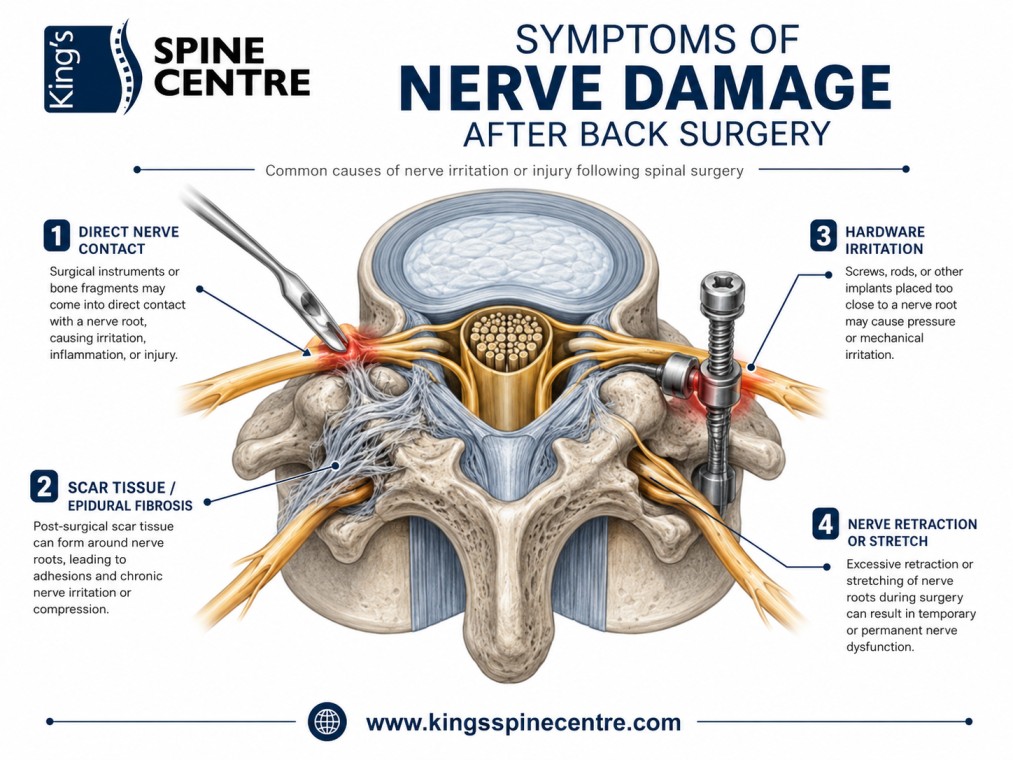
Direct trauma: Surgical instruments may stretch or press on a nerve root while the surgeon works around it.
Prolonged retraction: Nerves held under tension for a long operation can become temporarily irritated.
Reduced blood flow (ischaemia): Long or complex surgeries can briefly limit blood supply to nerve tissue.
Scar tissue (epidural fibrosis): As you heal, scar tissue can form around a nerve and compress it weeks or months later.
Hardware-related pressure: In fusion procedures, a screw or rod sitting close to a nerve can cause irritation.
Risk Factors That Increase the Chance of Nerve Injury
Some patients carry a higher baseline risk. These factors include complex or revision surgery, severe nerve compression that existed for a long time before the operation, diabetes or existing peripheral neuropathy, smoking, and poor circulation. Understanding these risks before surgery helps you and your surgeon plan a safer approach.
Common Symptoms of Nerve Damage After Back Surgery

Nerve symptoms can appear straight after surgery or develop days to weeks later. They vary depending on which nerve was affected and how severely. The most common warning signs include the following.
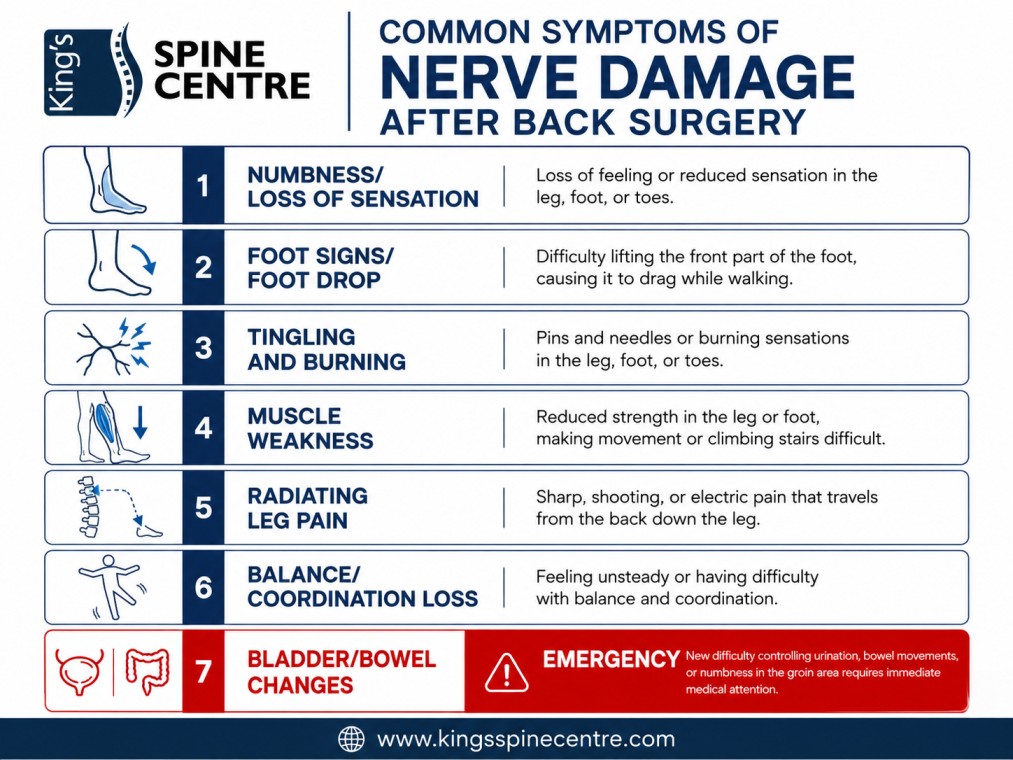
1. Numbness or Loss of Sensation
A reduced or absent feeling in the legs, feet, or buttocks is one of the clearest symptoms of nerve damage after back surgery. Some numbness in the first few days is normal, but new leg numbness after back surgery that appears suddenly, spreads, or fails to improve deserves a call to your surgeon.
2. Signs of Nerve Damage in the Foot
The foot is supplied by nerves that travel all the way down from the lower spine, so it is often where patients first notice a problem. Typical signs of nerve damage in foot after surgery include persistent numbness across the top or sole of the foot, a “dead” or heavy feeling, burning at the toes, or a foot that drags slightly when you walk (sometimes called foot drop). Because these signs of nerve damage in foot after surgery can point to a specific nerve root, they are worth reporting in detail.
3. Tingling, Burning, or “Pins and Needles”
Abnormal nerve signalling produces paraesthesia — tingling, prickling, burning, or electric-shock sensations along the path of the nerve. On its own, mild tingling can simply be a healing nerve. When it is intense, constant, or worsening, it may signal ongoing irritation.
4. Muscle Weakness
If a motor nerve is affected, you may notice weakness in a specific muscle group — difficulty lifting the foot, climbing stairs, or pushing off when walking. Progressive weakness is one of the more concerning nerve damage from surgery symptoms and should be assessed quickly.
5. Radiating Pain Down the Leg
Sharp pain that shoots from the back or buttock down the leg can indicate that a nerve is still being irritated or compressed. If you would like to understand the wider picture of leg pain from a pinched nerve, our overview of sciatica treatment in Dubai explains how the sciatic nerve produces these symptoms.
6. Loss of Balance or Coordination
When sensory nerves are not feeding accurate information back to the brain, balance suffers. Patients sometimes report feeling unsteady or unsure of where their feet are.
7. Bowel or Bladder Changes — A Medical Emergency
Loss of bladder or bowel control, or numbness around the saddle/groin area, can indicate cauda equina syndrome. This is a surgical emergency. Do not wait — seek immediate care.
Read – What Helps Nerve Pain in Legs After Back Surgery? A Relief and Recovery Guide
Signs of Nerve Damage From Epidural Anaesthesia
Many spine operations use spinal or epidural anaesthesia, and patients often ask specifically about the signs of nerve damage from epidural. True nerve injury from an epidural is rare, but it is worth knowing what to look for. The signs of nerve damage from epidural usually appear as numbness, tingling, weakness, or a band-like patch of altered sensation that lasts well beyond the time the anaesthetic should have worn off.
Most epidural-related numbness fades within hours as the medication clears. If altered sensation, signs of nerve damage from epidural, or weakness persist beyond a day — or get worse rather than better — report it promptly so it can be evaluated.

How Long Do Symptoms Last — Temporary vs. Permanent?
This is the question almost every patient asks, and the honest answer is: it depends on the cause.
Temporary symptoms come from mild irritation, swelling, or stretching during surgery. They tend to fade as inflammation settles, and many patients see steady improvement across the first 6 to 12 weeks. A nerve that was compressed for a long time before surgery can also take months to “wake up” as it recovers.
Permanent nerve damage after back surgery is far less common. It is more likely when a nerve was severely injured, compressed for a very long time before the operation, or affected by a complication such as bleeding or infection. The usual red flags that permanent nerve damage after back surgery may be developing are symptoms that fail to improve after about three months, or symptoms that steadily worsen rather than settle.
When Delayed Nerve Symptoms Appear
Sometimes nerve damage after surgery shows up late. Scar tissue can gradually wrap around a nerve, hardware can shift, or a disc can re-herniate at the same level. New numbness, weakness, or pain that begins weeks or months after you were recovering well should always be investigated.
How Doctors Diagnose Nerve Damage After Surgery
If you report concerning symptoms, your spine specialist will examine you and may order tests to find the exact cause.
MRI: The primary tool for viewing nerves, discs, and scar tissue. Our spine MRI in Dubai service produces the detailed soft-tissue images surgeons rely on after surgery.
EMG and nerve conduction studies: These measure how well your nerves and muscles are working and are usually done a few weeks after surgery, once early swelling has settled.
CT myelography: Useful when spinal hardware makes an MRI harder to read.
Accurate diagnosis is what allows the team to decide whether your symptoms are part of normal healing or a sign that the nerve needs further treatment.
Types and Grades of Nerve Injury
Not all nerve injuries are the same, and understanding the type helps explain why some patients recover quickly while others take longer. Doctors broadly group nerve injuries into three levels of severity.
Neurapraxia (mild): The nerve is bruised or temporarily blocked but not torn. This is the most common and most recoverable form, often settling within weeks.
Axonotmesis (moderate): The nerve fibres are damaged but the protective sheath remains intact, allowing the nerve to slowly regrow. Recovery can take months.
Neurotmesis (severe): The nerve is significantly disrupted. This is rare in spine surgery and is the type most associated with permanent nerve damage after back surgery.
Most patients who notice nerve damage from surgery symptoms fall into the mildest category, which is why early assessment and reassurance matter so much.
What to Expect in the First Weeks of Recovery
In the days right after surgery, it is normal to feel some numbness, soreness, and occasional tingling around the operated area. As the swelling settles, these sensations usually ease. Many patients find that mild numbness gives way to more normal feeling over the first six to twelve weeks.
What you are watching for is the direction of travel. Symptoms that gradually improve are reassuring. Symptoms that stay the same for many weeks, or that get worse — particularly new leg numbness after back surgery, spreading weakness, or escalating pain — are the ones that warrant a call to your surgeon. Keeping a simple daily note of your symptoms can help your spine team see the pattern clearly at your follow-up.
How to Lower Your Risk of Nerve Injury Before Surgery
While no operation is risk-free, several steps reduce the chance of complications. Choosing an experienced spine surgeon who uses minimally invasive techniques and intraoperative nerve monitoring is one of the most important. Optimising your health beforehand — controlling diabetes, stopping smoking, and improving general fitness — also helps your nerves recover better should any irritation occur. A thorough pre-operative assessment, including detailed imaging, allows the surgical team to plan the safest possible approach for your specific anatomy.
Can Nerve Damage After Back Surgery Be Treated?
In most cases, yes. The right approach depends on the cause and severity, and early action improves the odds of a full recovery. Options range from neuropathic pain medication and a structured spine rehabilitation programme, to targeted pain management, and — when imaging shows ongoing compression — further decompression or lumbar spine surgery. Our companion guide on what helps nerve pain in the legs after back surgery covers these relief options in detail.
Read – How long does it take for nerves to heal after back surgery?
When Should You Call Your Surgeon?
Contact your spine team — or seek urgent care — if you notice:
- Sudden loss of sensation in the legs or feet
New or worsening muscle weakness
Any difficulty controlling your bladder or bowels
Severe or rapidly escalating pain in the back or legs
Numbness around the groin or inner thighs
Catching these nerve damage from surgery symptoms early is what protects your long-term mobility.
Why Patients Choose King's Spine Centre, Dubai
As an integral part of King’s College Hospital, King’s Spine Centre brings together UK-, US-, and internationally trained spine surgeons and neurosurgeons under one roof in Dubai. The team — led by Director Prof. Dr. Imtiaz Hashmi — specialises in minimally invasive spine surgery (MISS), microsurgery, and complex revision procedures, supported by spinal neuronavigation and intraoperative imaging that help protect nerves during surgery. If you are experiencing any symptoms of nerve damage after back surgery, you can meet the full clinical team and have your concerns assessed by experienced specialists.
Final Thoughts
Mild aches and slow-fading numbness are a normal part of healing, but nerve symptoms should never be brushed aside. Persistent numbness, the signs of nerve damage in foot after surgery, unexplained weakness, or signs of nerve damage from epidural that outlast the anaesthetic all deserve a professional review. Early diagnosis is the difference between a temporary setback and a lasting problem.
If you are worried about the symptoms of nerve damage after back surgery, do not wait it out alone. Book a consultation with King’s Spine Centre in Dubai and let our specialists give you clear answers and a personalised recovery plan.
Frequently Asked Questions (FAQs) About Symptoms of Nerve Damage After Back Surgery
Some numbness in the first days to weeks is common as nerves recover from surgery and swelling. Numbness that is new, spreading, or worsening — or that does not improve over time — should be reported to your surgeon.
The most common signs are numbness, tingling or burning, muscle weakness, radiating leg pain, and balance problems. Loss of bladder or bowel control is an emergency and needs immediate care.
True nerve injury from an epidural is rare. The signs of nerve damage from epidural include numbness, tingling, or weakness that lasts well beyond the time the anaesthetic should have worn off. Report any such symptoms promptly.
Mild, temporary symptoms often improve over 6 to 12 weeks. Recovery from a more significant injury can take several months. Symptoms that persist beyond three months or worsen may indicate permanent nerve damage and should be evaluated.
Seek urgent help for sudden numbness, new or worsening weakness, severe escalating pain, or any loss of bladder or bowel control.
In most cases nerve symptoms are temporary and improve as you heal. Permanent nerve damage after back surgery is uncommon and is more likely when a nerve was severely injured or compressed for a long time before surgery. Symptoms that fail to improve after about three months should be reviewed.
Many patients notice numbness, tingling, or burning more in the evening, when there are fewer distractions and the body is at rest. This does not necessarily mean the nerve is worsening, but persistent night pain that disturbs sleep is worth discussing with your spine specialist so it can be managed properly.
Medical Disclaimer
This content is for informational purposes only and is not a substitute for professional medical advice, diagnosis, or treatment. Always consult your physician or a qualified healthcare provider regarding any medical questions, symptoms, or conditions.
Medically Reviewed
Reviewed by the spine care team at King’s Spine Centre, Dubai — a multidisciplinary team of spine specialists, neurosurgeons, pain management physicians and physiotherapists following evidence-based, JCI-accredited care standards.
